 Coin Price Analysis
A return to $100,000 in 2027 is a scenario for Bitcoin, with no reliable way to assign it a probability from the evidence reviewed. BTC’s November 23 UTC reference close was $61,228. Reaching $100,000 from that observation would require a gain of about 63%. At a rounded 20 million BTC supply, it would imply a market value of about $2 trillion. That calculation makes the assumption visible. It does not estimate the money that must enter the market. CoinGecko historical BTC data
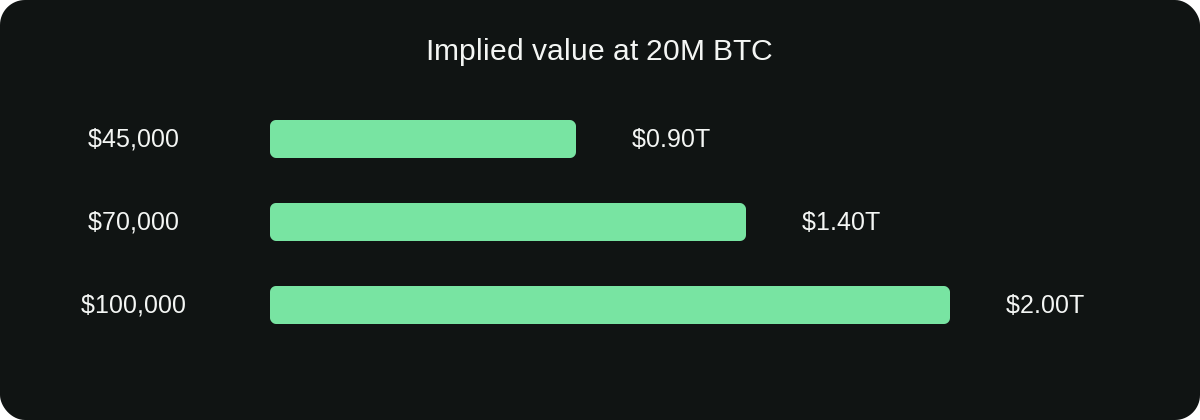
Three useful levels for the end of 2027
| BTC price assumption | Implied value at 20 million BTC | Evidence to watch |
|---|---|---|
| $45,000 | $900 billion | Persistent weakness across major spot markets and a sustained deterioration in demand indicators. |
| $70,000 | $1.4 trillion | BTC stabilizes and later recovers above the reference close, with demand visible beyond a single session. |
| $100,000 | $2.0 trillion | A larger repricing confirmed across venues and accompanied by persistent net demand. |
These are valuation tests for December 31, 2027, with no probabilities assigned. They are rounded reference levels selected to make changes in scale easy to understand. They do not set floors or ceilings. To reproduce the middle case, multiply $70,000 by 20 million. For a more precise figure, replace the rounded denominator with the circulating supply under your chosen methodology and date. Issuance continues, so a forward model should state its own supply assumption. Market value is the marginal price multiplied by a stock of coins. Buying $2 trillion of BTC is not a condition embedded in the $2 trillion figure.
What the November data establishes
CoinGecko’s USD history showed $58,818 on November 20, $60,121 on November 21, $61,172 on November 22 and $61,228 on November 23. The move from the first to the last observation was approximately 4.1%. These are reported daily closes in UTC. The November 24 row had no completed close in the retrieved view, so the most recent completed observation is the anchor here. The recent rebound establishes that the price rose on this interval. It cannot establish where traders placed stop orders, whether liquidations drove the move or whether a new cycle started. CoinGecko historical BTC data
The $58,818 and $61,228 observations can serve as reference points in a monitoring log. Calling the first a durable support level would require additional observations, including how the market trades near that area over time. A brief move above the latter number also says little without context about venue, volume and execution. Keep daily index observations separate from the bid and ask for a real order.
The two demand checks that matter most
Track holdings or net creations before interpreting ETF trading volume. An exchange-traded product’s trading volume records turnover in its shares. Buyers and sellers can trade existing shares without creating new ones. The market value of a fund can also rise when BTC appreciates without a proportional increase in the bitcoin it holds. To assess the demand claim, use the issuer’s holdings data and filing context across comparable dates. One fund is a useful observable example, with limited coverage of the broader market. iShares Bitcoin Trust ETF
Check where demand is visible. Compare equivalent spot series across venues using the same cutoff and quote currency. When a headline cites futures open interest or trading volume, record the product separately. A rise in those measures does not specify the net cash demand behind a spot price move. The case for a more durable repricing is stronger when it survives these distinctions across more than one date. It can weaken even after a price increase if the supporting data fades.
The longer-term supply question
Bitcoin’s issuance schedule reduces the block subsidy roughly every 210,000 blocks. The halving schedule tells you something useful about future new issuance. The exact calendar date depends on block production. The schedule does not tell you how much existing supply will be offered for sale, whether access products get net inflows or what a buyer will pay. Scarcity is an input to valuation. A projected halving date is not a forecast of when price will turn. Bitcoin.org halving documentation
For a longer-term outlook, write down the story the valuation requires. A bullish view may depend on more investors holding BTC over time, recurring access through regulated products and continued operational confidence in custody. A weaker case can arise when available access remains strong but holdings flatten, or when the quoted price rises while a real exit becomes more expensive. Commit to periodic checks of the actual evidence before changing the model.
A repeatable update requires only a dated price, a supply assumption and at least one independently observable demand measure. Update the first two before comparing implied valuations. Update the demand evidence separately. This keeps a changing numerical reference from turning into an unexplained change in investment thesis.
A fund can report a higher dollar value on a day when the amount of bitcoin held barely changes. When the number you want is demand, compare changes in BTC holdings or shares outstanding over the same dates. If you are comparing with another asset, carry those same observation dates across the analysis so that a broad market move does not look like a difference in fundamentals. Ethereum requires an additional check on staking issuance and fee burn, because its supply response to recent activity differs from Bitcoin's scheduled subsidy. Ethereum’s 2027 outlook
Frequently asked questions
Is $100,000 the same as a new all-time high? A round number is independent of the record high. Use one price series and a defined intraday or closing convention when checking records.
Can I compare a dollar target with my return in euros? Convert entry and exit using the corresponding exchange rates and account for actual charges. Your local-currency result can differ from USD performance.
How should a model handle a 2027 price spike that reverses before December? Set intrayear high and year-end close as separate outputs. A brief trade at the target does not satisfy a year-end forecast.